Fluorite
The rainbow-banded stone people reach for to clear a cluttered mind — a crystal of focus, clarity and calm order.
Calcium fluoride · The focus stone
Fluorite is calcium fluoride (CaF₂), the most colourful mineral in the world — often banded in purple, green, blue and clear within a single piece. In the crystal tradition it’s the “genius stone,” reached for to clear mental fog, sharpen focus and bring calm order to a busy mind, which is why it’s a favourite study and desk crystal tied to the third eye. It’s soft (4 Mohs), fragile and can fade in strong sun, so it needs gentle care. Below — meaning, how to use it, how to keep it, and how to tell it from glass.
If crystals had a stone for the overwhelmed modern mind, it would be fluorite. Cool, glassy and banded in ribbons of purple and green, it looks as orderly as it’s said to make you feel. The crystal tradition calls it the “genius stone” and reaches for it to cut through mental clutter, settle racing thoughts and bring a sense of calm structure — which is why it lives on so many desks and study tables. It’s beautiful, affordable, and a little delicate.
This guide covers what fluorite actually is, where its name and reputation come from, how people use it, how to keep a soft stone safe, and what’s tradition versus what’s genuinely known.
What is fluorite?
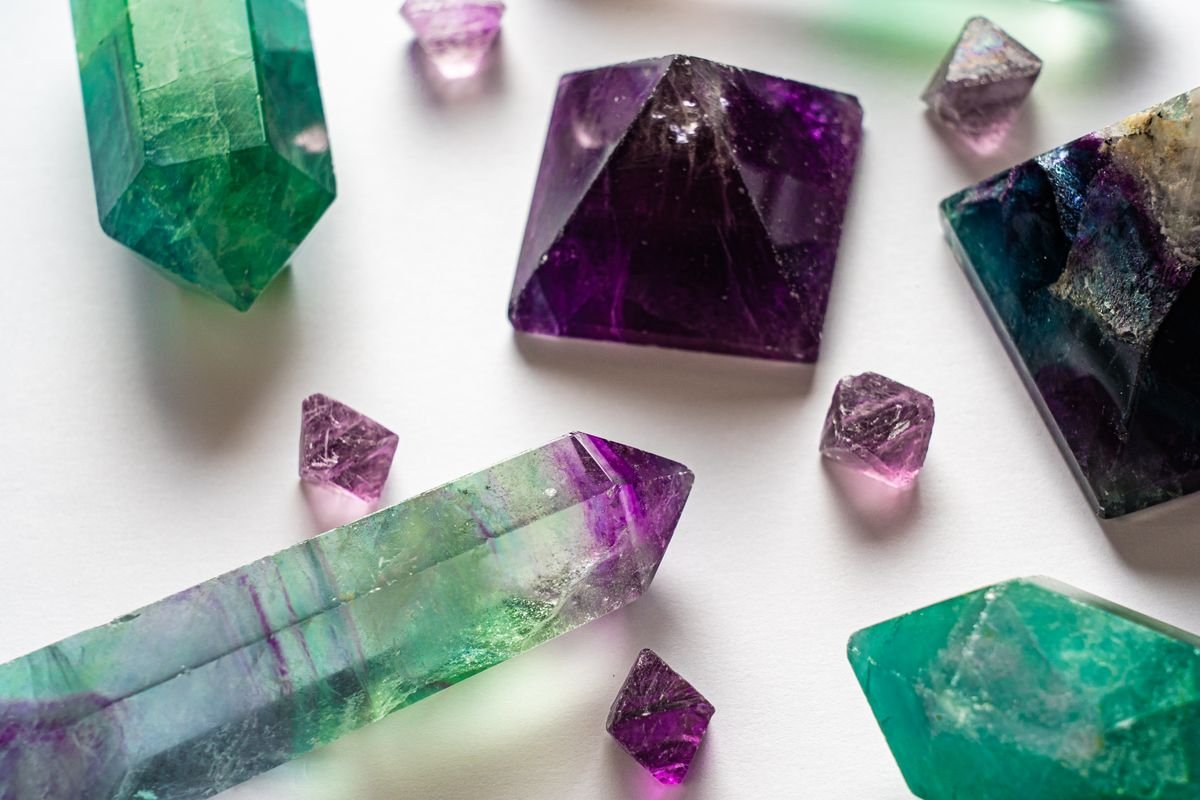
Fluorite is calcium fluoride, CaF₂ — a halide mineral that crystallises in cubes and octahedra and comes in a wider range of colours than almost any other mineral: purple, green, blue, yellow, pink and colourless, often zoned together in the famous “rainbow fluorite.” Many specimens glow under ultraviolet light — the very phenomenon of fluorescence is named after fluorite.
It is soft, just 4 on the Mohs scale (it’s the reference mineral for that number), with perfect octahedral cleavage that makes it chip and cleave easily under a knock. It is also mildly photosensitive — some fluorite fades in prolonged strong sunlight. So while it’s lovely and inexpensive, it’s a stone to treat gently. Most fluorite today comes from China, Mexico and, historically, England (the banded blue-purple “Blue John” of Derbyshire).
Fluorite meaning & history
Fluorite’s beauty has been prized since antiquity. The Romans are believed to have carved precious cups from banded fluorite (murrina), and England’s Blue John has been worked into vases and ornaments since the 18th century. Its very name comes from the Latin fluere, “to flow,” for its industrial use as a flux in smelting — a fitting root for a stone the crystal world links to mental flow.
In the modern crystal tradition, fluorite became the “genius stone” and the great study crystal: a stone for concentration, learning and tidy thinking. Its orderly cubic structure and clean colour banding made it a natural symbol for bringing order out of chaos — clearing a foggy head the way it clears light.
Fluorite healing properties
In the crystal tradition, fluorite is valued above all as a stone of the mind — clarity, focus and calm structure.
People typically turn to fluorite for:
- Focus. The classic study and work stone for concentration.
- Mental clarity. Said to clear fog and tidy scattered thoughts.
- Order & decisions. A crystal for organising ideas and choosing calmly.
- Calm. A steadying presence for an overstimulated mind.
These are traditional and symbolic uses, not medical claims. Fluorite is sometimes sold as a remedy for concentration disorders or other conditions — there is no scientific evidence that any crystal treats illness or improves cognition. Enjoy fluorite as a calming, focusing ritual and a beautiful object on your desk; it is not a treatment, and nothing here is intended to diagnose or cure any condition.
Fluorite, the chakras & zodiac
Fluorite is linked above all to the third eye chakra (Ajna), the centre of insight, focus and mental clarity. Colour refines this: purple fluorite reaches toward the crown for intuition, green fluorite toward the heart for emotional clarity, and blue toward calm communication. Rainbow fluorite, with several colours, is felt as an all-round mental tonic.
By zodiac it’s often associated with Pisces and Capricorn — dreaminess that benefits from structure, and structure that benefits from imagination. It has no birthstone month, but it’s a popular, thoughtful gift for students and busy minds.
How to use fluorite
Most uses revolve around focus and a calm, clear mind.
- Keep it on your desk. The classic study stone for concentration and tidy thinking.
- Hold it while you work or revise. A focusing anchor during deep work.
- Carry a tumbled stone. A pocket piece for overstimulating days.
- Wear it close to you. A fluorite necklace keeps its focusing presence with you through long days and meetings — natural rainbow stones set in silver or steel.
- Use it in meditation. At the third eye, for clarity and stillness.
- Keep it out of the sun. Place it where it won’t sit in all-day light, which can fade it.
How to cleanse & charge fluorite
Fluorite is soft and a little water-shy, so favour gentle methods.
- Smoke. Sage, palo santo or incense — safe and no-contact.
- Selenite. Rest it on a selenite plate overnight.
- Moonlight. A gentle full-moon charge (not sunlight).
- Sound. A singing bowl suits beads and small pieces.
- Brief cool water. A quick rinse is fine; dry it at once and never soak it.
Avoid salt water, long soaking, ultrasonic cleaners (the cleavage can shatter), and especially prolonged strong sun, which can soften its colour. Moonlight or a quartz cluster is the safe way to recharge it. Cleanse it whenever your mind has felt especially cluttered.
Types & colours
Fluorite’s range of colour is its signature:
- Rainbow fluorite. Banded purple, green and clear — the all-round favourite.
- Purple fluorite. Linked to intuition and the third eye/crown.
- Green fluorite. Linked to the heart and emotional clarity.
- Blue John. The historic banded blue-purple fluorite of Derbyshire, England.
- Yttrian (yttrium) fluorite. A rarer violet-blue collector variety.
Is fluorite rare or valuable?
Fluorite is affordable and widely available — tumbles, towers and spheres of rainbow fluorite cost little, which is part of its charm. Value rises with fine, gem-clear crystals, strong colour zoning and large flawless carvings; collector specimens and historic Blue John can be genuinely valuable. For everyday use, it’s a budget-friendly stone with a luxurious look.
Quality comes down to clarity, colour and the crispness of the banding. Because it’s soft and easily carved, beware suspiciously flawless, heavy “fluorite” that’s actually glass (see below).
How to tell real fluorite from fake
Fluorite is most often imitated by dyed glass or resin, which mimics its colourful banding.
- Look for natural zoning. Real fluorite shows angular, geometric colour zones following its cubic structure. Smooth, swirly, paint-like colour suggests glass.
- Watch for bubbles. Round internal air bubbles mean glass, not crystal.
- Hardness. Fluorite is soft (4) and won’t scratch glass; if a “fluorite” easily scratches a glass bottle, be suspicious (test gently, on a piece you can risk).
- Feel the temperature. Fluorite feels cool and substantial; warm, light pieces hint at resin.
- UV glow. Many natural fluorites fluoresce under UV light — a helpful (if not absolute) sign.
Genuine, ethically sourced fluorite
If you’d like a piece of your own, Minerals Kingdom offers authenticated natural fluorite — rainbow towers, tumbles and specimens.