Moonstone
Captured moonlight — the stone of intuition, cycles and new beginnings.
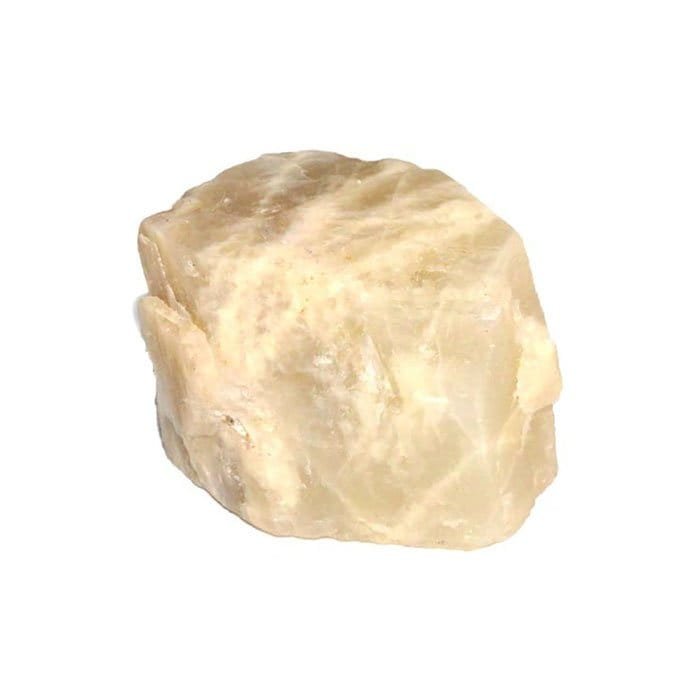
Pierre de lune · Feldspar family
Moonstone is a variety of feldspar famous for its adularescence — a soft blue-white light that seems to float and roll across the stone like moonlight on water. In the tradition it’s the great stone of intuition, emotional balance and new beginnings, tied to the moon, the third eye and feminine, cyclical energy. It’s the June birthstone. Below — what it is, where its lunar meaning comes from, how to use and keep it, the varieties you’ll meet, and how to tell it from man-made glass.
Tilt a moonstone in the light and you’ll understand its name instantly: a soft, billowing glow seems to drift just beneath the surface, pale blue or silvery-white, exactly like moonlight caught on water. That floating light has made moonstone one of the most romantic and beloved stones for thousands of years — the crystal of intuition, of the moon, and of every kind of new beginning. Where carnelian fires you into action, moonstone asks you to trust the quieter, inner knowing.
This guide covers everything worth knowing: what moonstone actually is and where that glow comes from, the lunar lore behind its meaning, the ways people use it, how to keep it safely, the colours and varieties you’ll meet, and how to tell a real stone from the man-made glass often sold in its place. As always, we’ll keep the lore and the facts clearly labelled.
What is moonstone?
Moonstone is a gem variety of feldspar, one of the most common mineral families on Earth. What makes it special isn’t its chemistry but its inner structure: moonstone is built from extremely thin, alternating layers of two feldspars (orthoclase and albite). When light enters the stone it scatters off these microscopic layers, producing that signature shimmering glow. Gemmologists call the effect adularescence — named after Mount Adular in Switzerland, an early source — and it’s the whole reason moonstone is treasured.
On the Mohs scale moonstone sits around 6 to 6.5 — durable enough for jewellery, but softer than quartz and, like all feldspars, prone to splitting along internal planes called cleavage if it’s knocked hard. That’s worth remembering when you wear or clean it. The best stones have a near-colourless, transparent body with a strong blue sheen that seems to move as you turn them.
Because the glow depends on those internal layers rather than on colour, moonstone comes in many body tones — white, peach, grey, even near-black — each with its own character, which we’ll come to below.
Moonstone meaning & history
The meaning is in the name, and it’s wonderfully literal. The Romans believed moonstone was solidified moonlight, and both they and the Greeks linked it to their lunar deities. In India, where it has been sacred for millennia, it was considered a holy stone of the moon, traditionally given to couples as a wedding gift and believed to carry the light of the moon goddess.
From those roots, moonstone became the stone of everything the moon governs: intuition, cycles, emotion, fertility and new beginnings. It was the “traveller’s stone,” carried for protection on journeys, especially at night. In more recent history it had a great moment during the Art Nouveau period, when jewellers like René Lalique set its dreamy glow into some of their most famous pieces.
Today moonstone is read in that same gentle, lunar register — a stone of inner knowing, emotional flow and fresh starts. It’s the crystal people reach for at thresholds: a new chapter, a new moon, a leap they’re not quite sure of.
Moonstone healing properties
In the crystal tradition, moonstone is above all a stone of intuition and emotional balance. It’s the one most often suggested for tuning into your inner voice, smoothing emotional ups and downs, and supporting any kind of new beginning. Because of its lunar, cyclical associations it’s also strongly linked to feminine energy and to the body’s natural rhythms.
People most often turn to moonstone for:
- Intuition. A classic stone for trusting your inner knowing and gut feeling.
- Emotional balance. Said to soothe overreaction and bring calm to changeable moods.
- New beginnings. A talisman for fresh starts, transitions and setting intentions.
- Feminine & cyclical energy. Long associated with the moon, intuition and natural rhythms.
These are traditional and symbolic uses, not medical claims. Moonstone is a lovely focus for reflection, intuition and new starts — it is not a treatment, and nothing here is intended to diagnose or cure any condition, including anything relating to fertility or pregnancy. For health matters, please speak with a qualified professional.
Moonstone, the chakras & zodiac
In chakra work, moonstone is linked above all to the third eye chakra (Ajna), the centre of intuition and inner sight, and to the crown chakra (Sahasrara) for higher awareness. Because of its feminine, flowing associations it’s also tied to the sacral chakra, the seat of emotion and creativity — which is part of why it’s read as a stone that balances head and heart.
Moonstone is a birthstone for June (alongside pearl and alexandrite), making it a meaningful early-summer gift. Astrologically it’s most associated with moon-ruled Cancer, and often with Libra and Scorpio. As a lunar, intuitive stone it’s connected to the element of Water.
How to use moonstone
Moonstone is gentle and easy to live with. Most of the ways people use it are about intuition, calm and marking new chapters.
- Wear it. Moonstone is a favourite in rings and pendants — kept close, it keeps its intuitive, calming associations with you through the day.
- Keep it by the bed. A stone on the nightstand or under the pillow is a traditional aid for restful sleep and vivid dreams.
- Hold it in reflection. Use a smooth stone as a focus while you sit with a decision and listen for your gut response.
- Set new-moon intentions. Many people hold moonstone while setting intentions at the new moon, then “charge” it under the full moon.
- Carry it when travelling. A nod to its old role as the traveller’s stone.
How to cleanse & charge moonstone
Moonstone is easy to care for with one or two cautions. As a feldspar it’s a little softer than quartz and can split along its cleavage if knocked, so handle it gently and store it away from harder stones. A brief rinse won’t hurt it, but it shouldn’t be soaked for long, and salt should be avoided as it can dull the surface.
Good ways to cleanse moonstone:
- Moonlight. The obvious and perfect choice — a night under the full moon both cleanses and charges it beautifully.
- Smoke. Pass it through incense, palo santo or sage smoke.
- Selenite. Rest it on a selenite plate overnight.
- Sound. A singing bowl or bell is a gentle, no-contact option.
- Brief water. A quick rinse in cool water is fine; skip salt water and long soaks.
Moonstone and the moon are inseparable, so most people simply recharge it on the windowsill under a full moon — fitting, easy and colour-safe. Keep it out of long, harsh sunlight to be safe.
Types & colours of moonstone
“Moonstone” covers a lovely range, defined by body colour and the kind of glow:
- Blue (Sri Lankan) moonstone. The classic and most prized — a clear, colourless body with a vivid floating blue sheen. Increasingly rare.
- Rainbow moonstone. Milky-white with flashes of blue, gold and violet. Beautiful and popular — though, strictly, it’s a white labradorite rather than true moonstone (see below).
- Peach / pink moonstone. A warm, soft body colour with a gentle sheen; read as a more nurturing, heart-centred stone.
- Grey moonstone. A smoky, mysterious body — sometimes called “new moon” stone.
- Cat’s-eye & star moonstone. Rare stones that show a moving line of light or a star when cut as a dome.
Fine moonstone comes mainly from Sri Lanka (the source of the best blue material) and India (much of the rainbow and peach), with stones also from Madagascar, Myanmar, Brazil and the United States.
Is moonstone rare or valuable?
It depends enormously on quality. Common white and rainbow moonstone is abundant and very affordable. But fine blue moonstone — a transparent, colourless body with a strong, mobile blue sheen — is genuinely scarce, especially in larger sizes, and the best Sri Lankan stones command real prices.
Value is driven by the quality of the adularescence (a vivid blue that floats cleanly across the stone is best), the clarity of the body, and size. As ever, the honest advice is to choose the stone whose glow genuinely catches your eye — a small piece with a beautiful, living sheen is worth more, to most people, than a large, flat one.
How to tell real moonstone from fake
The most common imitation is opalite — a man-made glass with a milky body and a bluish glow that’s frequently sold as moonstone (or as “sea opal”). It’s pretty, but it isn’t a natural stone. A few honest checks help:
- Watch how the light moves. Real moonstone’s blue sheen shifts and rolls as you tilt it (adularescence). Opalite’s glow is flatter and looks the same from every angle.
- Hold it to the light. Opalite typically glows orange/amber when light passes through it and blue in reflected light — a giveaway of man-made glass.
- Look for natural character. Real moonstone often has tiny internal cleavage cracks (sometimes called “centipede” inclusions); opalite is usually flawlessly clean with round bubbles.
- Feel the temperature. Natural stone feels cool and warms slowly; glass warms quickly in the hand.
“Rainbow moonstone,” by the way, isn’t a fake — it’s just technically white labradorite, a very close feldspar cousin. It’s a beautiful, genuine stone; the name is simply a trade convention. If origin matters to you, buy from a seller who is clear about what a stone actually is.
Genuine, natural moonstone
If you’d like a piece of your own, Minerals Kingdom offers authenticated natural moonstone — tumbled stones, cabochons and jewellery, with the variety and any treatment stated honestly.