Larimar
The Caribbean-blue stone found in one place on earth — the dolphin stone of calm, and a mine that is running out.
Pectolite · The Atlantis stone
Larimar is the blue variety of pectolite, and it comes from exactly one deposit on earth: a single mountainside in the Dominican Republic. In the crystal tradition it’s a stone of calm, clear speech and sea-like serenity, nicknamed the dolphin stone and, more fancifully, the Atlantis stone. It’s moderately soft (4.5–5 Mohs) and, like celestite, its colour fades in sunlight. Supply is finite and prices have climbed steadily. Below — meaning, how to use it, how to keep the blue, and how to spot the dyed imitations.
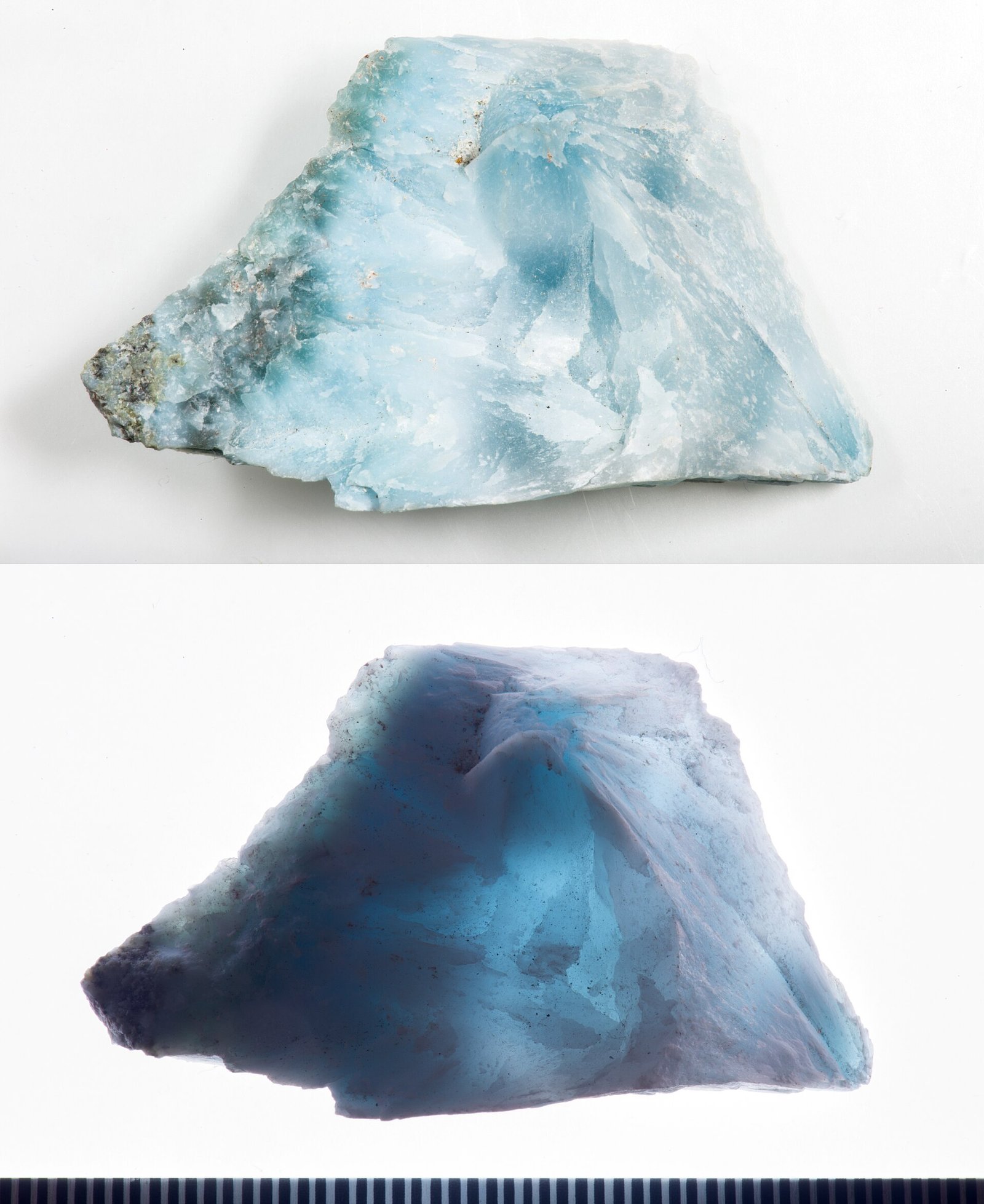
Larimar looks like an aerial photograph of the Caribbean: sky-blue pools separated by white foam, ringed with turquoise shallows. That is not a coincidence of poetry — the pattern comes from volcanic gas bubbles filled and refilled with mineral, and it happens to reproduce, in stone, exactly what water does over sand. It is one of the loveliest things a rock can do.
This guide covers what larimar actually is, where it comes from, what to make of its Atlantis legend, how people use it, and how to protect a colour that daylight steals.
What is larimar?
Larimar is pectolite — a sodium calcium silicate — in a variety coloured blue by copper substituting for calcium. Ordinary pectolite is white or grey and occurs worldwide; blue pectolite occurs in the Bahoruco mountain range of the Dominican Republic, in a working of a few square kilometres, and nowhere else that has ever been found.
It formed in cavities in basaltic lava, where hot copper-bearing fluids crystallised into radiating fibrous masses. Those radiating fibres are what give polished larimar its silky, slightly chatoyant sheen.
It is 4.5 to 5 on the Mohs scale — softer than glass — and tough enough to polish beautifully but not to shrug off a knock. Its Spanish name was coined in 1974 by Miguel Méndez, who combined his daughter’s name, Larissa, with mar, the sea. It had been found earlier, in 1916, by a priest whose request to mine it was refused.
Larimar meaning & history
Larimar has, by any reasonable measure, fifty years of history. It was named in 1974. It has no ancient tradition, no Taíno lore that can be documented, no classical mention.
What it has instead is a legend attached to it after the fact. Edgar Cayce, the American psychic, is said to have predicted that a blue stone of Atlantis would be found in the Caribbean. When larimar surfaced, the prophecy was retrofitted. It is now sold everywhere as the “Atlantis stone”. There is no Atlantis, and Cayce never named larimar. We mention this because the claim is on half the labels you will see, and you deserve to know what it is worth.
Its honest modern meanings — calm, clear speech, the serenity of water — need no legend at all. It is blue, it looks like the sea, and it is one of the gentlest-feeling stones there is.
Larimar healing properties
In the crystal tradition, larimar is valued as a stone of calm, clear communication and emotional soothing.
People typically turn to larimar for:
- Calm. The classic use — a cooling, sea-like stone for stress.
- Clear speech. A throat-chakra stone for saying things simply.
- Emotional soothing. Reached for during overwhelm.
- Release of old patterns. Associated with letting go.
These are traditional and symbolic uses, not medical claims. Larimar is sometimes sold for the throat, for stress, or for “Atlantean healing”. There is no scientific evidence that any crystal treats illness, and Atlantis did not exist. Enjoy larimar as a rare and beautiful stone from one Caribbean mountain; nothing here is intended to diagnose or cure any condition.
Larimar, the chakras & zodiac
Larimar is a throat chakra (Vishuddha) stone, associated with expression and, more particularly, with calm expression under pressure. Some practitioners also link it to the heart, for its gentleness.
By zodiac it’s most often associated with Leo — a curious pairing of the coolest stone with the hottest sign, which the tradition reads as balance. It has no birthstone month.
How to use larimar
Most uses revolve around calm and speech.
- Hold it in stressful moments. The stone’s most common use.
- Wear it at the throat. A larimar pendant — the classic setting.
- Carry a small tumble. Cool, smooth, easy in the hand.
- Use it in meditation. At the throat, for stillness.
- Keep it out of the sun. Including on your wrist, on holiday.
- Buy it once, properly. Given the mine’s finite life, one good piece beats three bad ones.
How to cleanse & charge larimar
Soft and light-sensitive: care is gentle and shady.
- Water. A brief cool rinse is tolerable; dry it at once.
- Moonlight. The right charge for this stone.
- Smoke. Sage, palo santo or incense.
- Selenite. Rest it on a plate.
- Soft cloth. To keep the polish.
Never charge larimar in sunlight. Prolonged UV exposure fades the blue permanently — the copper colouring is not lightfast. Avoid heat, harsh chemicals, ultrasonic cleaners and salt water. A larimar bracelet worn every summer day will be visibly paler after a few years, and this is the commonest complaint from owners.
Grades & patterns
- AAA / volcanic blue. Deep, even sky-blue with high contrast. The top grade.
- AA. Good blue with more white, still handsome.
- A / B grade. Mostly white with blue patches; inexpensive.
- Red or brown larimar. Iron-stained material from the weathered zone.
Is larimar rare or valuable?
Genuinely rare, and increasingly so. One deposit, hand-worked in narrow shafts, in a country where the mining is largely artisanal. Prices have risen steadily for two decades, and deep-blue material has risen fastest.
Low grades are affordable. Fine volcanic-blue cabochons run to hundreds of euros, and large clean pieces considerably more. This is one of the few stones on this site where the scarcity story on the label is actually true — which makes the imitations, below, all the more predictable.
How to tell real larimar from fake
Rarity plus a distinctive look equals imitation. There is a lot about.
- Dyed howlite or magnesite. The commonest fake. Uniform blue, grey web veins, and very soft — scratched by a coin. Larimar’s pattern is never web-like.
- Look for the fibres. Real larimar shows a faint radiating, silky texture from its fibrous crystals. Dyed rock does not.
- Look for the white. Genuine larimar’s white areas are part of the mineral, blending softly. Painted backing shows a hard edge.
- Acetone on a cotton bud. On a discreet spot. Blue on the cotton means dye.
- Beware plastic and resin. Warm to the touch, light, no cool weight.
- Beware the price. Cheap, deep-blue “larimar” is not larimar.
Genuine, ethically sourced larimar
If you’d like a piece of your own, Minerals Kingdom offers authenticated Dominican larimar — cabochons, tumbles and pendants.